
If the aim is to become a player with some strategic space of its own, not just in the Indian Ocean region but also in the adjoining region, then greater interaction with China is desirable, even necessary.

'No matter how severe sanctions the UN security council imposes on North Korea, the impact of the sanctions would depend on how faithfully they are enforced by China,' says Dr Rajaram Panda.

'With the recent challenging of the notion of the Indian Ocean Region being India's strategic backyard, China is gradually upping the ante in the maritime realm around India.'

In spite of irritants and hiccups in the relationship, a few deliverables are expected of the prime minister's visit to China, says Rup Narayan Das.
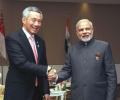
Prime Minister Narendra Modi's visit is an attempt to move the Indo-Singapore relationship to the 'next level'. Singapore has been one of the top investors in India. India-Singapore bilateral trade has already crossed the $15 billion mark. As per the official records, Singapore has emerged as the second largest source of Foreign Direct Investment in India, says Dr Rahul Mishra.

'Prime Minister Manmohan Singh may be anxious for a farewell visit to Washington in October,' says retired Ambassador K C Singh, 'but bending backwards on America's PRISM policy is going to earn him scorn at home and contempt abroad.'
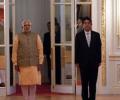
Narendra Modi and his government should look at the emerging geo-politics realistically and not get sucked into having to make a choice between China and Japan. India has enough economic space for both, says Mohan Guruswamy.

There is speculation that China released the White Paper on Tibet in a hurry after a Spanish court agreed to hear charges of genocide against former Chinese president Hu Jintao. Ajai Shukla reports

Two US warships fired at least 50 cruise missiles at the Ash Shai'rat airfield in Homs province in western Syria, from where the US administration believes Syrian President Bashar Al-Assad fired the chemical weapons against his own people, media reports said.

'If, as appears to be the case, India is on way to 'mending fences' with China, and China is equally desirous to 'reset' the relationship, this could be a self-reflexive moment in India's positioning vis-a-vis not just the Dalai Lama, but also the Tibetan issue and China as a whole,' points out China expert Alka Acharya.

'After more than 20 years of understanding, nothing much seems to have been achieved. What the two countries have been trying to do is to manage the recurrence of border incursions. The two sides must address the disease, and not the symptom of the disease,' says Rup Narayan Das.

China is spending billions of dollars to improve infrastructure in Tibet and other parts of its border with India. Claude Arpi explains why New Delhi can't afford to ignore Beijing's plans.


'It is certainly time for New Delhi to open up. Not only should it go ahead at full steam with the roads to the LAC, but the government must also allow tourists to visit these stunningly beautiful areas of Indian territory.'

Though the Chinese find it necessary to oppose the visits of Indian leaders to Arunachal Pradesh, they want to keep the objections at a moderate level lest it cast a shadow on Narendra Modi's visit to China in May, says D S Rajan.

People from all over Maharashtra come to watch the Shivgarjana dhol-tasha band in action. Paloma Sharma/Rediff.com find out why.
